Natural Learning vs. School Systems: Why One-Size-Fits-All Education Fails
A high school student explains why traditional education fails different learners and how to take control of your own learning.
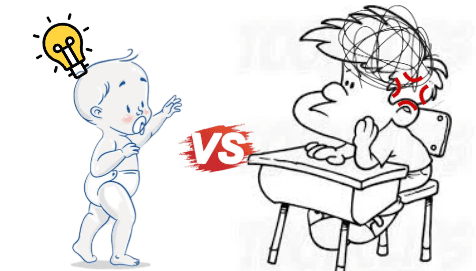
Every morning millions of kids around the world sit in identical rows, forcing their brain muscle to learn subjects in some cookie-cutter fashion. That isn't education; that's an assembly line. Just to be clear, this isn't a simple blog post or an X rant complaining about homework or a test score. This is about the school system that every single human is forced into, which ends up shaping the rest of their life.
Everyone is born the same way: as soon as they exit the womb, they are unable to fend for themselves, communicate, or even stand up. Yet we all learn to do these things, hopefully, through our guardians teaching us everything from walking to talking, using various methods as they figure out how to get through to a newborn.
However, once you reach a traditional school, that same logic of learning no longer applies. Suddenly, everyone is placed in a classroom and told to sit for hours on end, absorbing concepts through worksheets and lectures. Everyone knows, to some degree, that this feels more like an assembly line than a place of growth. Even the way desks are arranged, in columns, reflects that. Which is completely fine for those who thrive in it, but why is every single person forced into this system during the most formative years of their development?
Does One Size Fit All?
Imagine lining up every animal and telling them to complete the same task, whether that's climbing a tree, swimming, or passing a written test. That would be absurd. You wouldn't judge a fish by how well it climbs, and you wouldn't test humans on how well they can fly. Yet that's exactly how the school system treats us as "individuals," handing out state tests, SATs, and ACTs as if intelligence comes in one shape.
School also covers many basic topics like science and math, but fails to teach fundamental life skills like personal finance or understanding global issues. Floyd Mayweather, for example, built a billion-dollar boxing career through emotional intelligence, discipline, and marketing savviness, things they don't teach and you can't be easily tested on. His story proves that school isn't the defining factor of someone's success or intelligence. There are many different forms of intelligence that lead to different lifestyles, none of which can be measured by a standardized test.
What's Actually Happening in the Classroom
There have been times in school when I couldn't understand a topic no matter how long I studied. And then a friend explained it differently and it immediately clicked. Other times I was bored in class, easily grasping topics that everyone else struggled with.
Many of my friends hate sitting around for 8 hours a day without learning anything they're truly interested in. That's where cheating starts; people copy assignments just for the letter grade without caring about the actual content. I remember specifically in precalculus, I tried the entire period to understand a math rule and couldn't get it, even after watching videos at home. Then the next day, my friend explained it with real-world examples and thought experiments, and suddenly the "simplifying" and "functions" all made sense.
So What Should We Do Instead?
There is a way out of this cycle if you're looking for one. Personally, I've explored platforms that resonate with you, which can be as simple as a YouTube comment section. The end result is you engaging and actually learning things you care about.
I've also started using AI as a learning tool by training it to explain concepts in the way that works best for my brain, sometimes through animations tied to game mechanics, bridging things I already know to new topics. I've learned to ask better questions and reframe problems in ways that make sense to me.
There is some good news: with coming generations, we're learning to question the systems we live in, and institutions are starting to implement project-based learning and more hands-on approaches to subjects. Change is slow, but it's happening. The system isn't going away overnight. But understanding it and taking steps toward your own education is the first step to start learning on your own terms.
Written by Jerry Mota
@jerrymotaFounder of Learnsphere. High school student researching the gap between what school teaches and how the real world actually works. I write about social media dynamics, practical AI, productivity, and modern education through weekly research and personal experiments. Not a self-proclaimed expert—just someone figuring things out in real time.
Related Articles
Using AI as a Personal Tutor: Smarter Studying, Not Cheating
A student perspective on using AI tools like ChatGPT to actually understand schoolwork instead of just getting answers.
The Feynman Technique: How to Study Less and Understand More
Learn how to actually understand topics using a simple 4-step method used by one of the smartest scientists ever.