
Not Every Book Is a Novel
Stop wasting hours reading every word of heavy textbooks. Learn how inspectional reading helps you retain more information in half the time.
It's happened to almost all of us: our backpacks are as heavy as ever, and we're exhausted from carrying them around. Then you get home, open it up, and take out the 5-pound textbook. You sit down and force your eyes to start reading, but after just 2 minutes, your eyes seem to be looking at the words without understanding what you're actually reading. You spend another 30 minutes trying to lock in; however, when you're done, you barely remember the first page you read.
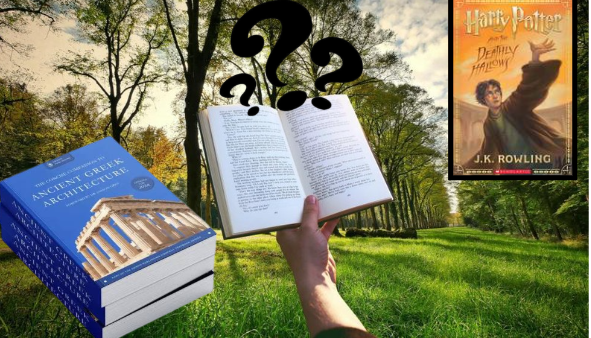
Reading a textbook like you read Harry Potter is a losing battle. It's not efficient, and it isn't how it's meant to be read. Textbooks are more like databases, where you don't need to look at everything to understand everything else. And once you understand what the columns and rows are by using "Inspectional Reading," you can cut your reading time in half, all while retaining information much better.
The Problem with Passive Reading
When you open your textbook and think that you're going to muscle through reading pages 270 to 310, even if you can focus for that long, your brain will go into "passive mode." According to cognitive science research from the Educational Psychology Review, when reading something as information-dense as a textbook without a clear plan or framework, your brain quickly starts to lose focus and you begin to gloss over ideas, resulting in poor memory of what you're reading. This is why, when learning something, you need a structure in the way you are taught rather than just reading something and hoping it sticks. This is where "inspectional reading" comes in.
The Simpler System
Instead of running face-first into a textbook, here is a simple framework I have personally used to keep my textbook reading under 2 hours while remembering over 90% of what I read:
Step 1: Spend 5 minutes just going through the chapters and understanding what you'll be learning
That means "spoiling the ending." Go to the first and last pages of the textbook chapter and take notes on the core concepts, so when you actually begin reading, you have an idea of what to expect.
Scan and note things that stand out visually: headers, subheaders, captions, and bolded words. For example, if there's a header like "Causes of the Great Depression," you can start asking, "What factors create a depression?"
Step 2: Skim pages
Now that you understand what exactly you're learning about, you can start reading, but this still doesn't mean dissecting everything:
- Focus on the first, middle, and last sentences. The first few sentences explain most concepts, the middle ones require a quick scan to see if you understand the concept, and the end summarizes what the topic was about.
- Look out for bold and italicized words, as they are key vocabulary terms for tests.
- After finishing a subtopic, take a quick 15 seconds to reflect: "What did I just learn?" If you can easily explain it, move on; if not, read only the section you don't fully understand.
Step 3: Summarize
After reading and double-checking that you understand, you'll most likely want to check your phone. But hold off for just 2 or 3 minutes and write a brief summary of everything you learned. Research published in the Journal of Educational Psychology shows that immediate active recall helps increase long-term memory.
Write down 3 key takeaways, 3 key terms, and at least one question you still have to expand on later.
The Difference
Passive linear reading: Reading cover-to-cover, highlighting entire sentences, and annotating and color-coding every section for an hour a day, only to forget half of what you learned the next day.
Inspectional reading: Pre-reading the summary, scanning headers, taking note only of words and phrases that stand out, doubling back only on concepts you don't fully understand, and doing a brief self-reflection. This takes under an hour while giving you much better memory retention.
The Rule About Textbooks
When I analyze how textbooks are created, I admire how fluid and formulaic the writing is. It's meant as a database to store information, not something you stare at all day hoping to memorize. By using a structured method to understand concepts as quickly and accurately as possible, you will free up much more time in your day for other priorities.
So next time you get assigned a textbook reading, don't read 200 pages cover-to-cover. Use inspectional reading to get what you need, and get out.
Written by Jerry Mota
@jerrymotaFounder of Learnsphere. High school student researching the gap between what school teaches and how the real world actually works. I write about social media dynamics, practical AI, productivity, and modern education through weekly research and personal experiments. Not a self-proclaimed expert—just someone figuring things out in real time.
Related Articles

Why Doing Fewer Extracurriculars Can Boost Your College Application
Why depth matters more than quantity in college applications, and how doing less can actually make you stand out.

Using AI as a Personal Tutor: Smarter Studying, Not Cheating
A student perspective on using AI tools like ChatGPT to actually understand schoolwork instead of just getting answers.